
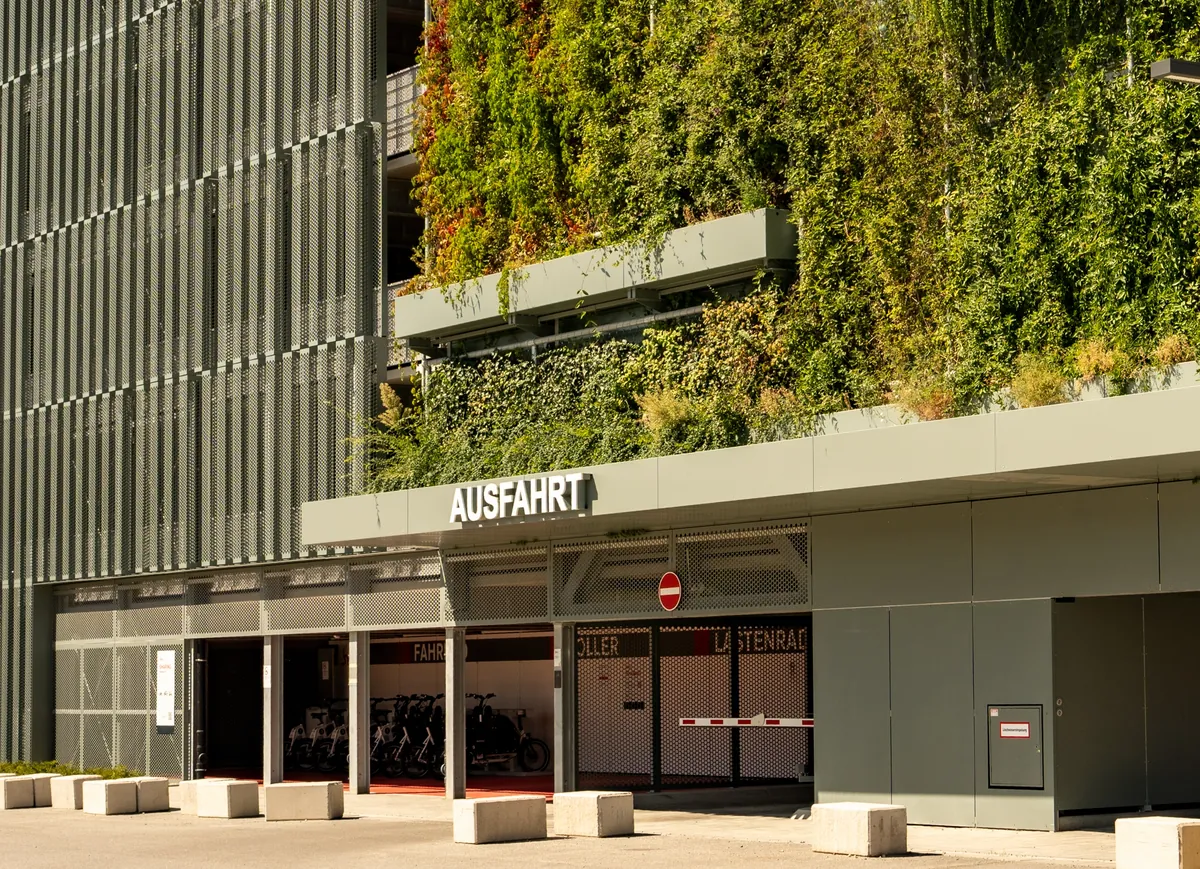
What sets a multi-storey apart from a car park
A multi-storey has few, built entrances. That makes control easier but every fault expensive: when a barrier fails, it is not one bay that stops but the whole deck behind it.
The second particularity is capacity. Unlike an open site, nobody can spill over. If everything is taken, the vehicle has to come back out through the same narrow ramp that others are trying to drive in on – a handful of drivers searching is enough to stall the entrance. That is why free capacity has to be readable before the entrance, not on level three.
Then there is the building itself. Cameras need power and a data connection at the entrances; sensors above every bay need both everywhere. What is structurally possible often decides more than what would be technically nicer.
When the barrier stays
A barrier is the right choice where access has to be hard-limited – in a building that regularly fills up, or where a deck is to stay reserved for certain users. Only mechanics can close physically.
Against it stands the operation: wear, faults, ticket supply and queuing at peak times. In a building with a single entrance, the second per vehicle decides whether traffic backs up onto the road.
The middle way is more common than many think: licence plate recognition for capture and billing, a barrier only where sealing off is genuinely needed. We build both and say openly which mixture suits your building.
When the car park barrier breaks down
A broken barrier is rarely just a repair job. If it stays down, nobody gets in – and the vehicles inside cannot get out. If it stays up, everyone drives in and out uncaptured, and nothing is billed for that period.
Until someone is on site, only staff at the entrance help. For many operators that moment is what triggers the switch – not the purchase price, but the second or third failure.
Licence plate recognition has less to break in that situation, because nothing moves. Where a barrier is genuinely needed, it can stay and be coupled to the capture – the existing equipment does not have to go.
Questions about running a multi-storey.
- Does a multi-storey need a barrier?
- Not necessarily. It is needed where access has to be physically limited. Where it is only about capture, billing and permits, licence plate recognition achieves the same without mechanics.
- What happens in a failure?
- If a barrier fails, the entrance stops until somebody is on site. If a camera fails, traffic keeps flowing and the session is added afterwards. That is the most important difference in day-to-day operation.
- How does occupancy display work without sensors?
- Through counting at the entrances. Every entry and exit is recorded and free capacity follows from it. That is enough for a display at the entrance, not for a display per bay.
- Can we keep an existing barrier?
- Yes. We integrate existing equipment rather than replacing it. Often the barrier stays at one entrance while billing moves to the number plate.
- Where does plate recognition reach its limits in a multi-storey?
- It reads what it can see. A covered, heavily soiled or damaged plate is not recognised reliably, nor is a vehicle without a front plate. Vehicles following closely on a narrow ramp can also make the assignment harder. Those cases need a second route: assignment afterwards through online payment, and review of the individual case.
Read on