
Hello hybrid parking
Two systems that complete each other.
A barrier – gate arm or roller door – protects entry and exit, licence plate recognition decides who may pass. Together they achieve more than either can alone.
Book a call
Your contact
Alessandro Seria·+49 9131 927825-1
What is hybrid parking?
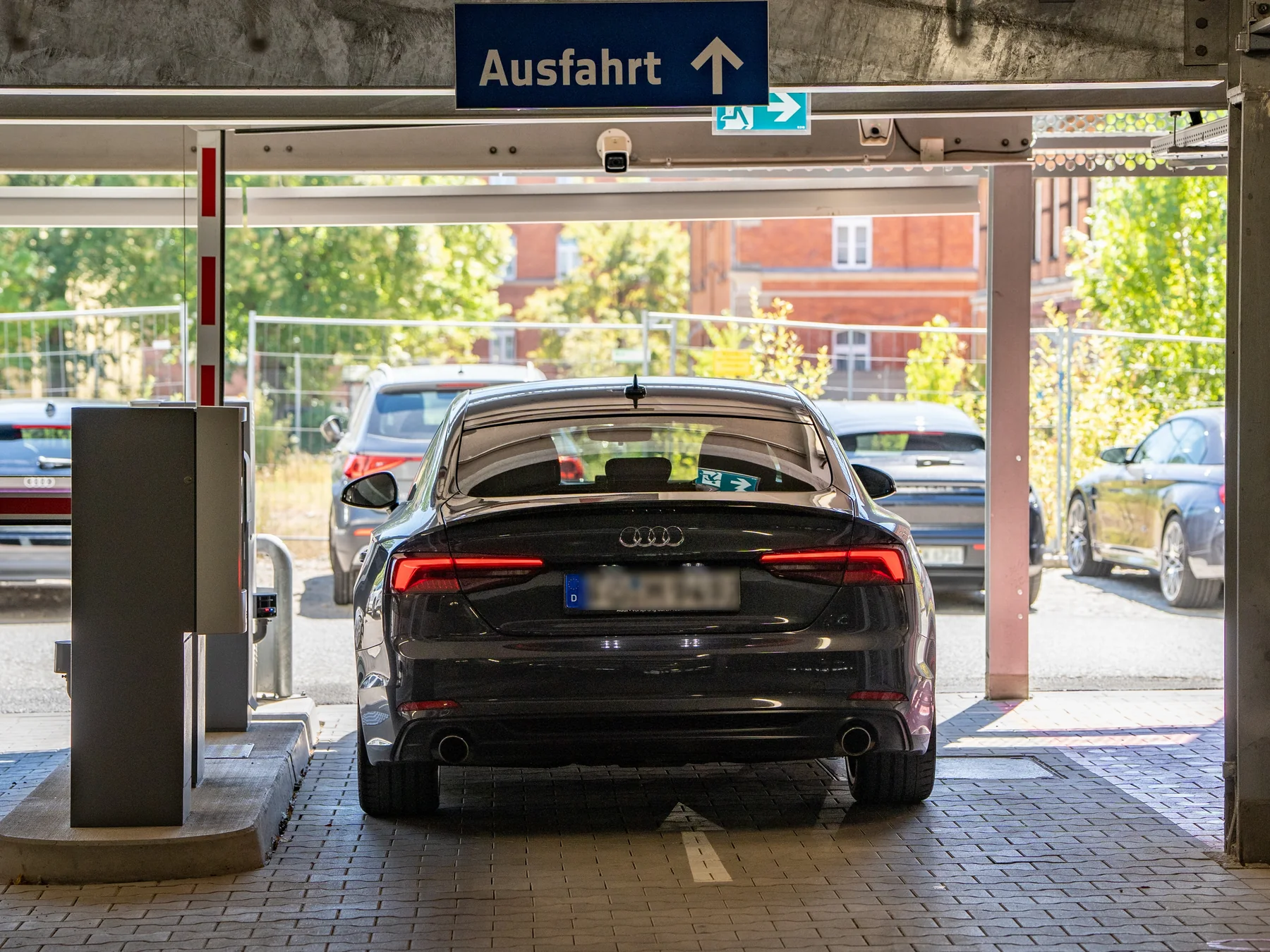
Hybrid parking joins a physical barrier to licence plate recognition and uses from each exactly what it is good at. Whether that barrier is a gate arm or a roller door makes no difference – both can be controlled. The barrier protects entry and exit and cannot be ignored. Licence plate recognition is the decision in front of it: it identifies every vehicle, knows its authorisation and judges at the moment the vehicle pulls up.
Taken on its own, each method has a gap. A barrier alone does not know who is standing in front of it, and therefore needs a ticket, a card or a code. A camera alone does know, but cannot stop anyone – it records what happens anyway.
Put together, that gap closes: the plate supplies the decision, the barrier enforces it. Reading happens at the front and at the rear – should a plate be unreadable once, under snow or dirt for instance, the second capture takes over.
When the barrier moves is up to you: for every vehicle, only at certain times, or permanently open. As a rule it stays down and rises as soon as the camera has read the plate – the stop lasts as long as the reading takes. Either way it stays ticketless: nothing to pull, nothing to show. Once the parking area reaches its capacity, the barrier stays down.
Anyone wanting to be doubly safe adds a ticket machine on the column. It only comes into play when a plate could not be read at either end – operation stays ticketless.
The most common reason for the combination.
Spaces that have to stay free
Not every site should be occupied down to the last space. Anyone with regular customers, tenants or deliveries has to keep their spaces free – at the moment they are needed, not just on the sign.
For that you store an allocation: up to a chosen occupancy everyone drives in. Once capacity is reached, the barrier stays down for general traffic.
That is precisely what cannot be done without the combination. A sign can be ignored, and a camera alone can only react afterwards through contractual penalties. The barrier is what turns the limit into a limit. Reservations can therefore be held and space availability guaranteed.
For a refusal to work in practice, the entrance needs two things: a screen that shows the reason, and room and enough time to turn around. Anyone facing a closed barrier has to see why – and get back out without reversing onto the road or causing a queue.
The whole process, seen from outside.
Parking with a barrier, but without a ticket.
A brief stop, the camera reads the plate. If it is authorised and there is space, the barrier swings up – no ticket, no button. Once capacity is reached, it stays down.
Two methods, each with a gap.
Barrier, plate or both?
Each of the two methods does something the other cannot. The table shows what remains once you put them together.
| Barrier only | Plate only | Hybrid parking | |
|---|---|---|---|
| Genuinely limiting entry | ✓The barrier stops everyone. | ✕Everything is captured, nobody is stopped. | ✓The barrier stops, the plate decides. |
| No ticket, no card | ✕Needs a ticket, a card or a code. | ✓Nothing to pull, nothing to show. | ✓Nothing to pull, nothing to show. |
| Enforcing an allocation | ✕Blocks everyone or no one. | ✕Knows who may enter but cannot block. | ✓Open up to capacity, then only the list. |
| Stopping at the entrance | ✕Pull a ticket, find a card, wait. | ✓No stop, straight through. | ✓A brief stop until the plate has been read. |
| Equipment in service | ✕Mechanics that can fail. | ✓Cameras only, no moving parts. | ✕Cameras and a barrier. |
Common questions
Common questions about hybrid parking
Contact